Thursday, April 16, 2009

Poetry Book Review - Youth Poets


Soft Hay Will Catch You: Poems by Young People
Compiled by Sandford Lyne

Introduction
Try some performance poetry to introduce this book authored by 130 young poets ages eight through eighteen who share their inner thoughts about solitude, home, the soul’s journey, discoveries, self, and our connections to place and family. Select a poem from the collection and as you recite it, use ASL signs to represent some of the poems’ main words.

A Wonderful Place

by Crystal Kim, grade 4


In my dreams I dream of a barn,

not just any barn,

a special barn.

When you go inside, a bright light shines,

and a ladder to heaven stands before you,

and if you fall--

no worry--

soft hay will catch you.


Golden Trail

by Mia Emerald Payne, grade 4


I took a walk 

upon a road of glory,

through the fields

painted yellow gold,

to the insects by the pond

and in the pool.

It was slower to my feet,

but faster to my heart.


Extension

Have your audience move their bodies to illustrate the above poems as you read them aloud (or others of your choice.) Challenge children to come up with movements that capture the spirit of the poem or the poet’s feelings. Play some soft music as an accompaniment, if you wish.


There is a companion volume featuring poems about childhood, family, nature, challenges, friendship, and spirit also assembled by Sandford Lyne during his career as a visiting poet-in-the-schools and participant in the Kennedy Center Arts in Education program.


Ten-Second Rainshowers: Poems by Young People

Compiled by Sandford Lyne


Lyne, Sandford, ed., and Julie Monks. 2004. Soft Hay Will Catch You: Poems by Young People. New York: Simon & Schuster.


-----, and Virginia Halstead. 1996. Ten-Second Rainshowers: Poems by Young People.  New York: Simon & Schuster.

Wednesday, April 15, 2009

Poetry Book Review - Paul B. Janeczko Collection


A Poke in the I: A Collection of Concrete Poems

by Paul B. Janeczko


Introduction

Before the group meets, reproduce one of the concrete poems in this book (or one of your favorites) on a large white board using colored dry erase markers - include an illustration, too. Discuss the concrete poem with the children - what do they notice about it? what shape does it form? how does the shape contribute to the poem? Draw arrows, circles, whatever, on the board highlighting the poem’s characteristics as they are discussed. Seeing you mark all over the board will illustrate that’s okay to do so, helping  your budding poets over the “blank page” hurdle when everyone tries creating their own concrete poems later.


Balloon 

by Colleen Thibaudeau


Extension

Download and print out the Candlewick Press Activity Kit available at the publisher’s website: http://www.candlewick.com/book_files/0763606618.kit.1.pdf

for tips and advice from Paul B. Janeczko for writing concrete poems and have students give their creativity free rein. Having a selection of color markers, color pencils, and white construction paper available will get things going, too. If time restrictions can’t be avoided, children can work on their poems in multiple sessions. Finished poems can be glued to colored construction paper sheets or wallpaper samples to give them frames or backdrops.


Be sure to share the companion volume by Janeczko and Raschka, too:


This title features twenty-nine different poetic forms ranging from the familiar haiku to the unusual pantoum (an interlocking series of quatrains) all designed to spark the imagination of the reader -- and make one start looking for a pencil to do one’s own!


Janeczko, Paul B., ed., and Chris Raschka. 2001. A Poke in the Eye: A Collection of Concrete Poems. Cambridge, MS: Candlewick Press.

-----, and Chris Raschka. 2005. A Kick in the Head: An Everyday Guide to Poetic Forms. Cambridge, MS: Candlewick Press. 


Monday, April 13, 2009

Poetry Break - Serious Poem


This Place I Know: Poems of Comfort

Selected by Georgia Heard


Introduction

Everyone must deal with the death of someone they care about at some point in their lives. Unfortunately, many times a child must try to make sense of what death actually is as well as figure out how to manage their feelings about it. To set the tone, wear drab-colored clothing and a sad face. Tell the children you are feeling very sad and ask them what things might make a person feel sad. The poems in this collection were chosen by Georgia Heard to offer comfort to the schoolchildren in Manhattan who witnessed the World Trade Center tragedy.


Holes by Lillian Morrison


Strangest of gaps

their goneness --

mother, father, loved friends


the black holes

of the astronomer

are not more mysterious


this kind of hole

will not be filled

with candle flames

or even a thousand thoughts


the hole is inside us

it brims over

is empty and full at once.


Extension

Share how each poem in the book was illustrated by a famed picture book artist. Ask children to draw a picture of something that might help a sad person feel better. Have them share their drawings with the group, if they wish, and explain why they drew what they did.


Another picture poetry book about coping with the loss of a loved one:


Michael Rosen’s Sad Book

by Michael Rosen

Illustrated by Quentin Blake


In this book, the author writes about his own sadness at the death of his son, how it affected him, and some of the things he tried to cope with it.


Heard, Georgia. 2002. This Place I Know: Poems of Comfort. Cambridge, MS: Candlewick Press.


Rosen, Michael. 2004. Michael Rosen’s Sad Book. Cambridge, MS: Candlewick Press.


Sunday, April 5, 2009

Poetry Break - Newer Poetry Book

Oh, Theodore!: Guinea Pig Poems

by Susan Katz


Introduction

Since many classrooms in elementary schools have a resident guinea pig, bring one in for a visit. Talk a bit about the habits and characteristics of these popular pets. If time allows, share a number of poems from the book which chronicle the friendship between Theodore and his new owner.


Roomates


A faint whistle

In the dark.


What’s that?

I listen hard.


Sleepy wheet,

Soft chrrr.


Tiny peep,

Teeny squeep.


Theodore’s telling me,

Good night.


Sleep tight,

I whisper back.


I hope 

He doesn’t snore.


Extension

Guinea pigs are very popular pets. What kind of animal would they guess is the rarest pet every owned by someone in the group? Poll children to find out how many of them have ever had a dog, cat, or other animal as a pet. Graph the results onto poster board and glue on clip art pictures of the different types of pets represented. Perhaps discuss the pros and cons of owning an unusual pet.


Many other poetry books about pets are available:

Kirk, Daniel. 2003. Dogs Rule!. New York: Hyperion.

-----, 2007. Cat Power!. New York: Hyperion. 

        Both of these volumes come with an audio CD of the poet           and friends playing music and singing the poems.

George, Kristine O’Connell. Little Dog Poems. 1999.                          New York: Clarion.

Brown, Margaret Wise. Nibble, Nibble. 2007 (orig. 1959).                   New York: HarperCollins.

Gottfried, Maya. 2005. Good Dog. New York: Alfred A. Knopf 

Pearson, Susan. 2005. Who Swallowed Harold? and Other               Poems About Pets. New York: Marshall Cavendish.


Katz, Susan and Stacey Schuett. 2007. Oh Theodore!: Guinea          Pig Poems. New York: Clarion Books.

Friday, April 3, 2009

Poetry Break - New Poetry Book


In Aunt Giraffe’s Green Garden

by Jack Prelutsky


Introduction

Introduce children to the work of our Children’s Poet Laureate in this volume of “smiles and silliness.” Since many of the poems mention cities or states across the US, as you share each one, plot the place referenced on a map of North America.


In La Jolla, California


In La Jolla, California

Susu sat upon the sand,

Watching with a sense of wonder

How the water washed the land.


Susu saw, above the ocean,

Pelicans in graceful flight.

In La Jolla, California,

Susu laughed with great delight.


Extension

Perhaps your town or state has a “claim to fame” that would make a good subject for a silly poem. Try composing one together as a group or suggest children create a picture illustrating a local landmark or activity.


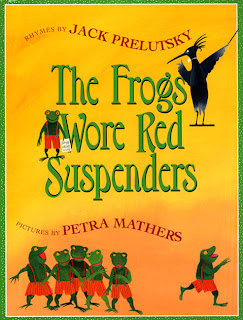
Don’t forget the companion volume, The Frog Wore Red Suspenders, published in 2002, and also illustrated by Petra Mathers.


Prelutsky, Jack and Petra Mathers. 2007. In Aunt Giraffe’s Green Garden. New York: Greenwillow Books/HarperCollins.


-----. 2002. The Frog Wore Red Suspenders. New York: Greenwillow Books/HarperCollins.

Sunday, March 29, 2009

Poetry Break - Poem with a Refrain


Hand in Hand: An American History Through Poetry

Collected by Lee Bennett Hopkins


Introduction

Share with children how the rhythm of the words in a poem forms an integral part of the listening experience by having the group pat softly on their legs in tempo to imitate the sound of a train on the tracks (pat,pat...pat,pat...pat,pat) while you read the following poem.


The Railroad Cars are Coming


The great Pacific railway,

   For California hail!

Bring on the locomotive,

   Lay down the iron rail;

Across the rolling prairies

   By steam we’re bound to go,

The railroad cars are coming, humming

   Through New Mexico.

The railroad cars are coming, humming

   Through New Mexico.


The little dogs in dog-town

   Will wag each little tail;

They’ll think that something’s coming

   A-riding on a rail.

The rattlesnake will show its fangs,

   The owl tu-whit, tu-who,

The railroad cars are coming, humming

   Through New Mexico.

The railroad cars are coming, humming

   Through New Mexico.


Extension

On repeated readings, children can join in reciting the final lines, and of course everyone can make the sound of train whistle fading in the distance at the end. As a trivia question, ask if anyone can identify the railway named partly for a New Mexico city. Answer: the Atchison,Topeka and Santa Fe Railway


Many other poems in this volume lend themselves to group choral reading:

Battle Won is Lost by Phil George

We Shall Overcome by Anonymous

Enemies by Charlotte Zolotow

What Shall We Do for the Striking Seamen? Traditional


Bennett, Lee Hopkins, ed. 1994. Hand in Hand: An American History Through Poetry. New York: Simon and Schuster.

Wednesday, March 25, 2009

Poetry Book Review - Biographical Poem

George Washington’s Teeth

by Deborah Chandra & Madeleine Comora

Brock Cole (Illustrator)

Introduction
Bring in small jars of baby food and share with students, having them taste with plastic spoons. Remind them this is the type of food one has to eat when one has no teeth to chew with! Eeewww! Then read aloud this humorous “tongue-in-cheek” poetic dental history of our first president.

 Excerpt:

Poor George had two teeth in his mouth

The day the votes came in.

The people had a President,

But one afraid to grin.

From battling toothaches while fighting the British, to having rotten teeth removed by his dentists, the Father of Our Country suffered all his life with tooth problems. Yet, contrary to popular belief, he never had a set of wooden teeth. Starting at the age of twenty-four, George Washington lost on average a tooth a year, and by the time he was elected President, he had only two left! In this reverentially funny tale written in verse and based on Washington’s letters, diaries, and other historical records, readers will find out what really happened as they follow the trail of lost teeth to complete “tooflessness.”

Illustrated in watercolors with subtle humor by Brock Cole, the main story is followed by a four-page time line featuring reproduced period portraits of Washington.

Extension
Since you will probably have plenty of baby food left over, have children mix the food with bird seed and spread the resulting paste on bread slices. Place the slices outside where the birds can find them and within sight of a window, if possible, so the children can watch other creatures without teeth eat!

Another good biographical poem choice:


Rough, Tough Charley

by Verla Kay

Charley was rough. Charley was tough. Charley wore fancy gloves.

This picture book biography tells in spare rhyme the story of Charley Parkhurst, one of the most respected stagecoach drivers in the Old West, who lived a life without limits – and who kept a startling secret.


Chandra, Deborah & Madeleine Comora. 2003. George Washington’s Teeth. New York: Farrar Straus Giroux.

Kay, Verla. 2007. Rough, Tough Charley. Berkeley, CA: Tricycle Press. 

Tuesday, March 24, 2009

Poetry Break - Poetry Across the Curriculum


Arithme-tickle: An Even Number of Odd Riddle-Rhymes

By J. Patrick Lewis

Introduction
Play a math guessing game with children. Tell them you are thinking of a number – the same number as planets in the solar system, for example. After they have experienced some success at solving this type of problem, read the following poem.


A Regular Riddle

What’s the number of points on a regular star,

Less the number of wheels on a regular car,

Plus the number of teeth in a regular mouth,

Less the number of states that begin with South,

Plus the number of paws on a malamute,

Plus the number of pants in a birthday suit,

Less the number of 17 brown bears’ thumbs?

Easy, if you know your regular sums.


Extension
Have children make up their own Arithme-riddle as a group project. Ask them to think of lines while you write them on a board or chart paper. Assemble the lines into a pleasing arrangement, then have them figure out the arithmetic answer to the riddle.

Answer: 5-4+32-2+4+0-34=1


Another excellent poetry book to use when studying history:


Voices of the Alamo
by Sherry Garland

Poems in different voices reflecting the perspectives of many men and women - Indian, Mexican, Spanish, Texan, and American - recount the history of the Alamo from the 1500s to the present.


Lewis, J. Patrick. 2002. Arithme-tickle. New York: Harcourt.

Garland, Sherry. 2000. Voices of the Alamo. Gretna, LA: Pelican Publishing.

Monday, March 23, 2009

Poetry Break - Spring Poem


Spring Song
By Barbara Seuling

Introduction
Discuss with children what are some of the signs of winter ending and spring arriving. What do some of the local animals and plants do when the weather begins to warm up?
Display pictures or samples of twigs with new leaves, a bird’s nest with egg, flowering tree branch, etc.

When the snow melts
and rushes down the mountainside,
what does the black bear do?
Wakes up to greet
a swimming treat.

When the sun warms
the hard ground and makes it soft,
what do moles do?
Dig a new row
of tunnels below.

When breezes stir
the air in woodland burrows,
what do striped skunks do?
Leave their den,
to roam again.

When tall reeds grow
across the marshy wetlands,
what do bullfrogs do?
Croak the night long,
their mating song.

When buds appear
on the cottonwood trees,
what do eagles do?
Build a high nest,
where newborns will rest.

When new grass grows
in the sunny meadow,
what do rabbits do?
Hop all over
in the clover.

When cocoons burst
open and release their prize,
what do people do?
Come out to cheer,
for spring is here!

Extension
Go on a scavenger hunt outside to find signs of spring or have children look around their own yards and bring in items for sharing the following day. A possible artistic response activity might be to have children choose an animal or plant and create a picture showing what it does in the spring.

Another fun spring picture book poem:


Splish, Splash, Spring
by Jan Carr


Seuling, Barbara. 2001. Spring Song. New York: Gulliver Books/Harcourt.

Carr, Jan. 2001. Splish, Splash, Spring. New York: Holiday House.

Wednesday, March 4, 2009

Poetry Break - Unusual Form


Technically, It’s Not My Fault
by John Grandits


I chose concrete poetry, inspired by John Grandits’ humorous look at the life of Robert, middle-schooler.

Introduction
Model creating a simple form of concrete poetry by showing students an object ( a plush cat, for example) and asking them to list words that identify parts of the item (ear, tail, whisker, etc.). Draw on outline of the object on a white board and write the words in the proper areas of the item. Then ask students to come up with additional words that tell how the item might smell, taste, or feel (soft), what kind of sound it makes (purr), what color it might be (tabby), or what movement it makes (pounce). Add those words to the board in appropriate places.

Share of selection of concrete poems from the book. Display copies of the poems as you read them on a smart board, with overhead transparencies, or using a presentation projector so students get the full effect of the concrete poems.


Click Picture to Enlarge

Extension
Prepare blank slips of white paper, just large enough for a single word to be printed on them. Have a bin of small items like a silk flower or leaf, a plastic bug, a toy car, a piece of plastic fruit, a marble, a kazoo, a selection of small plastic animals, a whistle, a doll, a rubber worm, etc. Have students each choose an item. Instruct them to print words that describe the item onto the paper slips and then arrange the slips into the shape of the item being profiled. They can glue the slips onto sheets of colored paper when they have an arrangement they like. Have them print a poem title and their names on the papers, then display for a class collection of concrete poetry. Older students might choose their own items based on a theme like “at the beach” or “Christmas time.”

Here’s another example from Love That Dog by Sharon Creech:


Grandits, John. 2004. Technically, its not my fault. New York: Clarion Books.

Creech, Sharon. 2001. Love that dog. New York: Joanna Cotler Books/HarperCollins.

Poetry Break - Poem Without Rhyme


And If the Moon Could Talk
   by Kate Banks

Introduction
Turn the lights out. Have students put their heads down on their desks and close their eyes. Ask them to imagine the items mentioned in the poem as you read it softly.

Somewhere a pair of shoes lies under a chair.
A window yawns open.
Twilight blazes a trail across the wall.
And if the moon could talk,
It would tell of evening
Stealing through the woods
And a lizard scurrying home to supper.

Someone hums quietly.
A clock ticks. A light flicks on.
And if the moon could talk,
It would tell of stars flaring up one by one
And a small fire burning by a tree.

Papa opens a book and turns the pages.
A story unfolds like a banner
Wandering across the sky.
And if the moon could talk,
It would tell of sand blowing across the desert
And nomads crouching by the dune.

On a small table sits a glass,
A wooden boat, a starfish, too.
And if the moon could talk,
It would tell of waves washing onto the beach,
Shells, and a crab resting.

Music chimes from a small box on a shelf.
A mobile stirs the air.
On a chair, a rabbit sits listening.
And if the moon could talk,
It would tell of the wind rocking a tree
And a bird safe in its nest.

Mama hands her child the rabbit.
She hugs her and pulls the blankets
Tight under her chin.
And if the moon could talk,
It would tell of a faraway den
And a lion licking her cubs.

Eyes close. There is a drowsy hush.
Darkness swells into a colorful dream.
And if the moon could talk,
It would tell of a child
Curled up in bed wrapped in sleep.
And it would murmur
Good night.

Extension
Have students think of something in their room at home or in their house. If that item could magically talk to you, what would it say? What emotion would it be feeling? Why?


Banks, Kate. 1998. And if the moon could talk. New York: Frances Foster Books/Farrar Straus Giroux.